
Breadcrumbs
These links will help you get back to where you want to go faster.
Why Are My Desert Tree Leaves Turning Yellow?
Expert Solutions for Healthy Landscaping in Queen Creek & San Tan Valley
Desert tree leaves turning yellow can be a frustrating and concerning sign for homeowners and landscapers in Queen Creek and San Tan Valley, Arizona. Despite careful watering and maintenance, the persistent challenge of alkaline, high-pH soils often locks essential nutrients—most notably iron—out of reach for tree roots. Understanding the underlying soil chemistry and its impact on plant health is crucial for reversing yellowing foliage and cultivating vibrant, thriving desert landscapes.
Are you looking for a reliable and trustworthy local landscaper and hardscaper? Let us bring your front and backyard to life! Call or text us at (480) 522-9675, or schedule a free online consultation for BBQ & Chimenea, Fire Pit, Putting Green, Sod, Turf, Block Wall, Outdoor Concrete Patio, Travertine Flooring, Paver, or Pergola & Gazebo installation.
Understanding Yellow Leaves: The Role of Iron Chlorosis in Desert Trees
What Causes Yellow Leaves in Desert Trees?
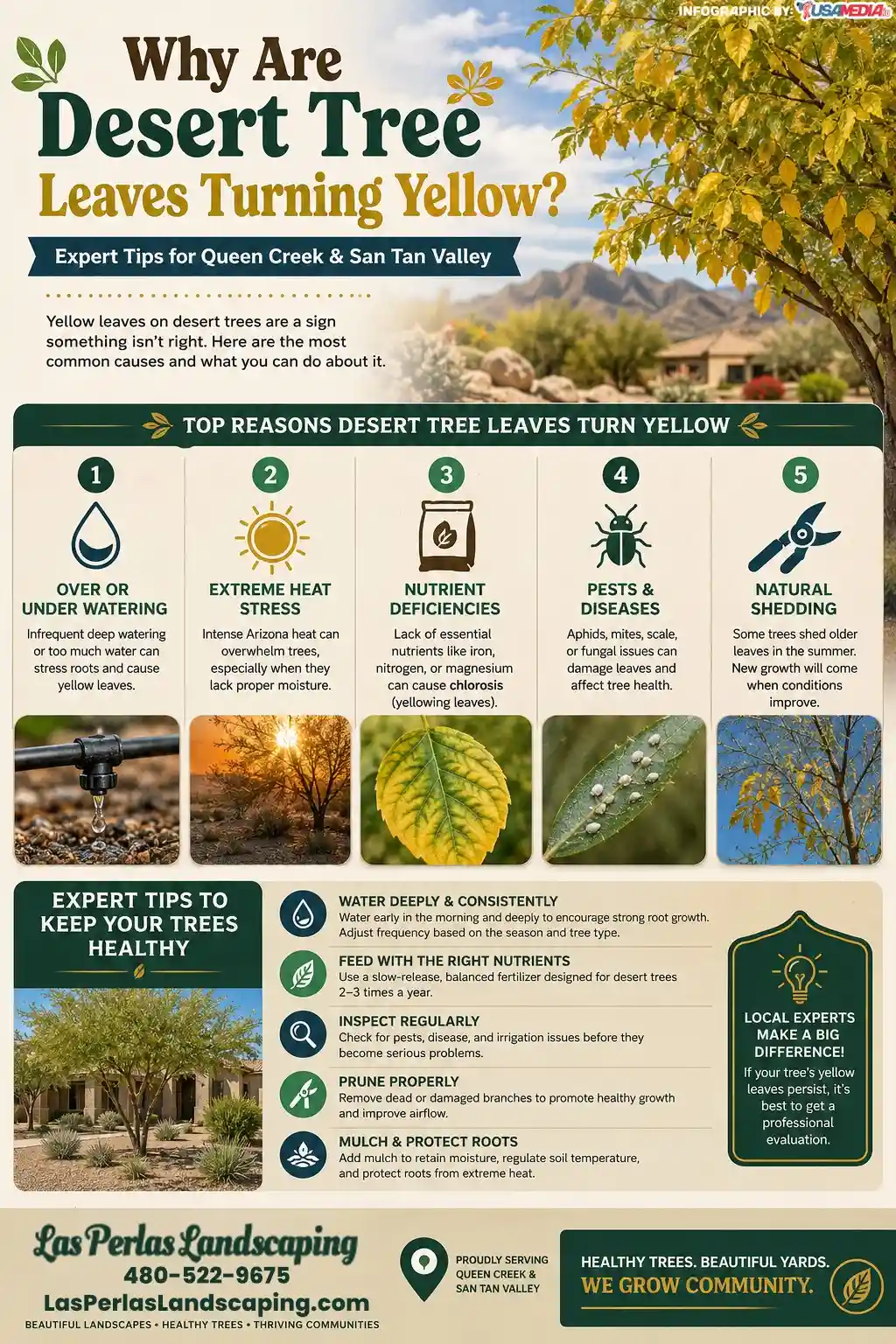
Yellowing leaves on otherwise healthy desert trees are commonly caused by iron chlorosis, a nutrient disorder triggered not by a lack of iron but by an inability of roots to absorb it. In the alkaline, high-pH soils prevalent in Arizona’s East Valley—often ranging from 7.5 to 8.5 and above—iron becomes chemically bound in forms that roots cannot access. This results in iron deficiency inside the plant despite sufficient iron present in the soil, leading to diminished chlorophyll production, the pigment critical for photosynthesis.
Recognizing Iron Deficiency: Key Symptoms
The hallmark of iron chlorosis is interveinal chlorosis, where the leaf tissue turns yellow but the veins remain distinctly green. This symptom clearly indicates iron starvation. Other signs include uniform yellowing of entire leaves, yellowing of new growth, brown edges around leaves, and wilting even when soil moisture is adequate. If untreated, iron chlorosis can severely weaken trees, causing branch dieback, stunted growth, and heightened vulnerability to pests and diseases.
The Science Behind Alkaline Soils and Nutrient Lock-Up
Why Are Queen Creek & San Tan Valley Soils Alkaline?
Desert soils in this region are naturally alkaline due to local geology, climate, and irrigation practices. When soil pH rises above neutral (7.0), iron transitions from ferrous (Fe²⁺), a soluble and plant-available form, to ferric forms (Fe³⁺), which tightly bind to soil particles and become inaccessible to roots. This chemical alteration impedes essential nutrient uptake, contributing to yellowing leaves and poor tree health.
Additional Factors Exacerbating the Problem
The soil chemistry challenge is compounded by several environmental and landscaping elements. Caliche layers—dense, cemented coatings rich in calcium carbonate—restrict root growth and nutrient access in deeper soil. Other complicating factors include:
- Use of alkaline well water high in calcium and magnesium
- Inert rock mulches, such as river rock or gravel, that do not acidify or enrich the soil
- Compacted soils lacking microbial activity essential for nutrient cycling
- Poor drainage leading to salt accumulation and pH imbalance
- Concrete barriers limiting root expansion and nutrient exploration
Identifying and Acting on Leaf Yellowing Patterns
Recognizing specific yellowing patterns in leaves allows timely diagnosis and tailored interventions. Common nutrient deficiency signs include:
- Interveinal chlorosis (yellow tissue with green veins): Classic indicator of iron deficiency; requires immediate attention.
- Uniformly pale yellow leaves: May signal nitrogen deficiency or progressing iron chlorosis; warrants monitoring.
- Yellowing on new growth first: Typical in iron unavailability due to alkaline soils, common in desert landscaping.
- Brown leaf edges with yellow centers: Suggests combination of magnesium, potassium, and iron deficiencies aggravated by pH issues.
- Wilting despite sufficient moisture: Reflects root stress from sustained nutrient deficiency and needs prompt professional care.
Local landscaping experts at Las Perlas Landscaping report that elevated soil pH causes about 80% of yellow-leaf cases in desert landscapes, underscoring the importance of addressing alkalinity.
Are you looking for a reliable and trustworthy local landscaper and hardscaper? Let us bring your front and backyard to life! Call or text us at (480) 522-9675, or schedule a free online consultation for BBQ & Chimenea, Fire Pit, Putting Green, Sod, Turf, Block Wall, Outdoor Concrete Patio, Travertine Flooring, Paver, or Pergola & Gazebo installation.
Tree Species Susceptibility: Which Trees Are Most Vulnerable?
Not all tree species respond equally to alkaline soil conditions and associated iron deficiencies. Awareness of species susceptibility informs both planting choices and remedial strategies.
Highly Susceptible Trees
- Fruit trees: Apricots, cherries, peaches, plums
- Ornamentals: Crape myrtles, liquidambars, birches, cottonwoods
- Shade trees: Select maples, ash, sycamores
- Specialty trees: Pistachios, pomegranates (depending on conditions)
More Tolerant Desert-Adapted Species
- Palo Verde: A native species with minimal iron demands
- Mesquite: Known for drought and alkalinity tolerance
- Desert Willow
- Various Acacia species
- Texas Privet
For sustainable and resilient desert landscapes, experts often prioritize alkaline-tolerant trees but also specialize in rehabilitating sensitive species.
Effective Strategies to Treat and Prevent Yellowing Leaves
Step 1: Professional Soil Testing
Accurate soil analysis is critical to confirm iron deficiency and identify other nutrient or pH imbalances before treatment. Professional testing examines pH, organic matter, iron availability, salt levels, and additional parameters to guide precise interventions that address the root causes rather than symptoms.
Step 2: Targeted Iron Treatments
Once nutrient deficiencies are diagnosed, a multi-pronged approach to iron supplementation and soil management yields best results.
- Chelated Iron Sprays: Applied to leaves for rapid visual improvement; however, effects are temporary and do not correct soil chemistry.
- Soil Injection of Iron Chelates: A longer-lasting method delivering bioavailable iron directly to roots, bypassing chemical blockages.
- Iron Sulfate Applications: A cost-effective supplement but less reliable in highly alkaline soils due to chemical limitations; best used alongside other treatments.
- Foliar Feeding: Repeated applications administer immediate nutrients to stressed foliage and complement soil-based therapies.
Step 3: Long-Term Soil pH Modification
Tackling alkaline soil’s root causes requires sustained efforts to lower and stabilize pH in a plant-accessible range. Recommended practices include:
- Incorporating acidifying amendments such as elemental sulfur or aluminum sulfate into the top soil layers (12–18 inches) to gradually reduce alkalinity.
- Adding organic matter—peat moss, well-aged compost, bark mulch—to encourage beneficial microbes that buffer soil pH and enhance nutrient cycling.
- Replacing inert rock mulches with organic ones to improve moisture retention and surface pH stability.
- Adjusting irrigation by utilizing rainwater or alternative lower-alkalinity sources instead of hard well water.
The Importance of Professional Expertise in Desert Landscaping
Many DIY remedies fail because they overlook the complex soil chemistry and physical barriers inherent to desert environments. Professional landscapers bring valuable expertise, including:
- Precise analysis of soil and water chemistry tailored for desert conditions.
- Customized treatment regimens aligned with specific tree species and local soil characteristics.
- Advanced methods to penetrate caliche layers and improve root zone access.
- Long-term maintenance plans to prevent recurring alkalinity and nutrient lockup.
Preventive Landscape Design: Building Resilient Desert Gardens
Prevention begins with informed species selection and thorough soil preparation to mitigate alkaline stresses before they affect plant health. Key considerations include:
- Choosing native or desert-adapted alkaline-tolerant species well-suited for Queen Creek and San Tan Valley soils.
- Diligent site preparation—breaking caliche, amending soil chemistry, and optimizing soil structure.
- Designing irrigation systems for deep, infrequent watering to promote strong root growth without waterlogging.
- Employing organic mulches and thoughtful hardscaping that enhance soil vitality over time.
Incorporating these practices ensures landscapes that combine aesthetic beauty with long-term ecological health.
Taking Action: Restore and Maintain Your Desert Landscape
Yellow leaves are a visible warning sign of deeper soil health issues that require more than superficial fixes. Collaborating with local experts like Las Perlas Landscaping ensures precise diagnosis and effective, lasting solutions tailored to desert conditions. Their services include:
- Comprehensive soil and plant health assessments to identify nutrient deficiencies and pH imbalances.
- Customized iron supplementation and soil pH correction plans designed for both rehabilitation and prevention.
- Landscape design and redesign using alkalinity-tolerant species optimized for thriving in local soils.
- Ongoing maintenance programs that protect tree health, enhance curb appeal, and reduce water and chemical use—saving money over time.
Restoring a vibrant desert oasis hinges on understanding soil chemistry and applying science-based horticultural practices. By partnering with skilled professionals familiar with Queen Creek and San Tan Valley’s unique soils, you can safeguard your trees’ health and enjoy lush, flourishing landscapes for years to come. Contact Las Perlas Landscaping today to schedule your soil analysis and begin transforming your outdoor space into a thriving desert paradise.
Are you looking for a reliable and trustworthy local landscaper and hardscaper? Let us bring your front and backyard to life! Call or text us at (480) 522-9675, or schedule a free online consultation for BBQ & Chimenea, Fire Pit, Putting Green, Sod, Turf, Block Wall, Outdoor Concrete Patio, Travertine Flooring, Paver, or Pergola & Gazebo installation.