
Breadcrumbs
These links will help you get back to where you want to go faster.
The High Cost of Hydration
Transforming San Tan Valley Landscaping Amid Rising Water Rates
San Tan Valley, Arizona, is undergoing a significant shift in its approach to residential and commercial landscaping. Once celebrated for its vibrant, water-thirsty green lawns, this desert community now faces escalating water rates, stringent regulations, and the environmental realities of a prolonged megadrought. These factors have compelled homeowners, HOAs, and property managers to rethink traditional landscaping in favor of sustainable, drought-resilient solutions that balance beauty, practicality, and conservation.
This article delves into the economic and environmental drivers behind rising water costs in San Tan Valley and highlights innovative landscaping strategies gaining traction. From smart irrigation technologies to xeriscaping and hardscaping, discover how local experts like Las Perlas Landscaping are helping residents adapt to these challenges with elegant, cost-effective outdoor designs.
The Escalating Water Challenge in San Tan Valley
Understanding the Regional Water Crisis
Water costs in San Tan Valley and greater Pinal County have surged by over 30% in the last five years, a trend fueled by an enduring megadrought affecting the American Southwest. With key reservoirs like Lake Mead and Lake Powell at historic lows, state and local water authorities have tightened allocation policies, introducing tiered pricing systems that heavily penalize excessive water use.
The typical residential water bill has climbed from approximately $45 per month in 2015 to over $70 today, while irrigation-intensive households can face charges as steep as $200 to $300 during peak summer months. Alongside scarcity, this increase reflects necessary investments in aging infrastructure and compliance with Arizona’s Active Management Area (AMA) rules, including limits on outdoor watering times.
Are you looking for a reliable and trustworthy local landscaper and hardscaper? Let us bring your front and backyard to life! Call or text us at (480) 522-9675, or schedule a free online consultation for BBQ & Chimenea, Fire Pit, Putting Green, Sod, Turf, Block Wall, Outdoor Concrete Patio, Travertine Flooring, Paver, or Pergola & Gazebo installation.
Utility Rate Hikes and Regulatory Responses
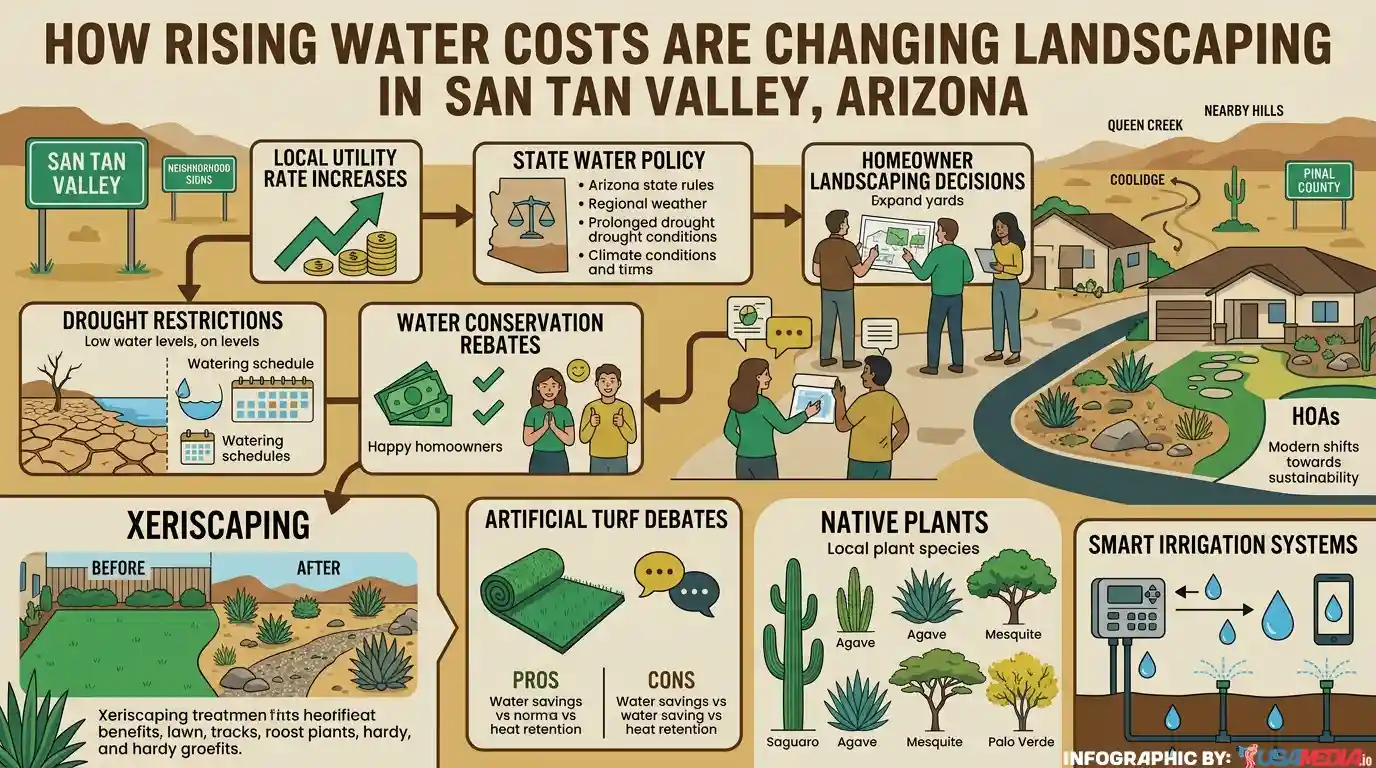
Water providers serving San Tan Valley, notably EPCOR, have implemented substantial rate increases to address drought pressures and maintain infrastructure integrity. In July 2025, the Arizona Corporation Commission authorized a 14.5% rate hike for EPCOR’s San Tan District, with wastewater fees also rising. These adjustments align with similar increases in neighboring municipalities, underscoring a broad regional effort to promote water conservation.
At the same time, outdoor watering restrictions now limit irrigation to select evenings during summer, fundamentally challenging the viability of traditional turf lawns. These restrictions are designed to reduce unnecessary consumption and encourage residents to adopt water-efficient landscaping alternatives.
Adapting Landscapes to New Realities
Homeowners Associations Redefining Yard Standards
Historically, many San Tan Valley neighborhoods governed by Homeowners Associations (HOAs) required lush green lawns to maintain curb appeal and community standards. Facing persistent droughts and soaring water bills, numerous HOAs have revised landscaping guidelines to embrace xeriscaping, native plants, and reduced turf areas.
Progressive HOAs balance neighborhood aesthetics with environmental stewardship by encouraging drought-tolerant landscapes, native vegetation, and integrated hardscaping features. This shift minimizes conflicts between conservation goals and community expectations, fostering greater homeowner flexibility while preserving property values.
Professional landscaping and hardscape contractors play a vital role in guiding these transitions, crafting water-wise designs that satisfy both HOA compliance and residents’ desires for attractive, functional outdoor spaces.
The Rise of Xeriscaping: Desert-Friendly Landscaping
Once considered a niche practice, xeriscaping has become the frontline landscaping strategy for San Tan Valley’s arid climate. Far from barren or monotonous, xeriscaped yards combine thoughtfully selected drought-tolerant native plants, advanced irrigation techniques, strategic hardscaping, and moisture-enhancing soil amendments to achieve a vibrant yet low-water landscape.
Key xeriscaping principles include opting for plants naturally adapted to tolerate the desert’s extreme heat—often exceeding 115°F—and scarce rainfall, grouping species by water needs (hydrozoning), and optimizing irrigation schedules for maximum efficiency. Such designs cut outdoor water consumption by 50–75%, delivering durable beauty with less environmental impact.
Popular native species thriving in San Tan Valley’s conditions include Palo Verde and Mesquite trees, Desert Marigold, Autumn Sage, Ironwood, Desert Willow, and Creosote Bush. These plants feature high resistance to pests and diseases, and once established require minimal supplemental watering, making them ideal choices for sustainable residential and commercial landscapes.
Innovative Water-Saving Landscaping Techniques
Smart Irrigation Systems Enhance Water Efficiency
Technological advances in irrigation have empowered homeowners to precisely manage landscape watering, reducing waste and costs. Smart irrigation controllers integrate local weather data, soil moisture sensors, and plant-specific watering requirements to dynamically adjust irrigation schedules, skipping watering during rain or cooler weather.
These intelligent systems typically reduce irrigation water use by 30–50%, translating into significant savings despite installation costs ranging between $1,000 and $2,500. Fortunately, local rebate programs offset a substantial portion of these expenses, often allowing homeowners to recover their investment within a few years through reduced utility bills.
Are you looking for a reliable and trustworthy local landscaper and hardscaper? Let us bring your front and backyard to life! Call or text us at (480) 522-9675, or schedule a free online consultation for BBQ & Chimenea, Fire Pit, Putting Green, Sod, Turf, Block Wall, Outdoor Concrete Patio, Travertine Flooring, Paver, or Pergola & Gazebo installation.
Hardscaping: Maximizing Outdoor Space Without Water
Replacing traditional turf areas with hardscaping elements such as paver patios, retaining walls, and decorative gravel has gained popularity as a water-conscious landscaping approach. These features extend usable outdoor living space, add property value, and require minimal upkeep—all while significantly lowering water demand.
Durable, maintenance-friendly paver installations, including permeable options that reduce runoff and erosion, complement native plantings and incorporate landscape lighting to create functional, attractive nighttime environments.
Artificial Turf: Pros, Cons, and Practical Hybrid Solutions
Artificial turf offers a compelling alternative to natural lawns by eliminating irrigation and lawn maintenance tasks like mowing and fertilizing. It maintains year-round greenery and a soft surface ideal for kids and pets.
However, artificial turf can absorb intense heat—often surpassing 140°F—contributing to higher localized temperatures, and raises environmental concerns including microplastic shedding and disposal issues in landfills. Additionally, some HOAs restrict artificial turf based on aesthetics or drainage concerns.
To balance these factors, many homeowners adopt hybrid landscaping designs, combining limited artificial turf areas with xeriscaping and hardscape elements for a sustainable, usable outdoor space.
Financial Incentives Fueling the Transition
To encourage water-efficient landscaping, local utilities and municipalities in Pinal County offer a variety of rebate programs targeting common upgrades. These include incentives for turf removal, smart irrigation controller installations, native plant purchases, and comprehensive landscape conversions.
| Rebate Type | Incentive Range | Application |
|---|---|---|
| Turf Removal | $1 – $3 per sq. ft. | Grass elimination |
| Irrigation Upgrades | $200 – $500 per property | Smart controllers and drip systems |
| Native Plant Purchases | $1 – $5 per plant | Drought-tolerant species |
| Landscape Conversion | Up to $1,000 per project | Xeriscape redesigns |
| Smart Controller Systems | $150 – $300 per system | WiFi-enabled irrigation |
These financial incentives make sustainable landscaping investments more accessible, helping homeowners recoup a significant portion of upfront costs estimated between $3,000 and $5,000. This support accelerates the community-wide move toward water-smart outdoor environments.
Commercial Landscaping and Regional Coordination
Rising water costs extend beyond residential properties, prompting commercial real estate in San Tan Valley to adopt water-efficient landscaping. Businesses implement drought-resistant plantings, hardscaping, and smart irrigation to reduce operating expenses while maintaining attractive, professional grounds that appeal to environmentally conscious clients.
These innovations align with broader Pinal County efforts covering cities like Casa Grande and Coolidge—demonstrating a regional commitment to water stewardship and sustainable landscaping practices.
Neighborhood Case Studies: Embracing Change Across San Tan Valley
Established communities like Copper Sky and newer subdivisions near Coolidge are leading by example, with HOAs endorsing xeriscaping and hardscaping through updated landscaping policies. New developments increasingly embrace water-wise landscaping as a default, meeting both buyer expectations and regulatory mandates.
Meanwhile, neighborhoods facing older infrastructure and legacy turf challenges are gradually transitioning as homeowners respond to rising water costs and conservation incentives. Local landscapers and hardscaping professionals guide these upgrades, ensuring compliance, functional design, and enhanced curb appeal.
Cultivating a Resilient, Sustainable Desert Landscape
The rapid rise in water rates and evolving regulatory landscape in San Tan Valley are reshaping how residents and businesses manage desert landscaping. Traditional, water-intensive lawns are no longer financially viable or environmentally sound in this arid region.
By adopting xeriscaping, smart irrigation, hardscaping, and native plantings, San Tan Valley is forging a sustainable path forward that conserves vital resources while preserving outdoor enjoyment and home value. Trusted local experts like Las Perlas Landscaping are at the forefront, delivering innovative, compliant solutions tailored to the community’s unique climate and water constraints.
Whether you are a homeowner or commercial property manager, now is the time to embrace water-wise landscaping strategies that reduce costs, increase resilience, and contribute to the sustainable stewardship of Arizona’s desert environment.
Contact Las Perlas Landscaping today to discover tailored solutions that beautify your property, lower water bills, and support a thriving, water-smart community.
Are you looking for a reliable and trustworthy local landscaper and hardscaper? Let us bring your front and backyard to life! Call or text us at (480) 522-9675, or schedule a free online consultation for BBQ & Chimenea, Fire Pit, Putting Green, Sod, Turf, Block Wall, Outdoor Concrete Patio, Travertine Flooring, Paver, or Pergola & Gazebo installation.